Speakup Blog
AAC 101
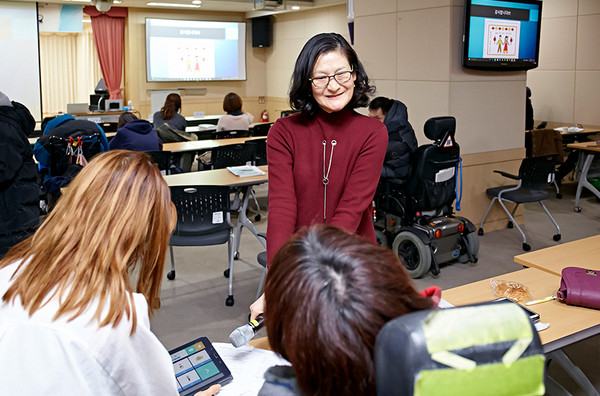 Dr. Chung is pictured giving a speech, entitled “Augmentative and Alternative Communication Support System in America and My Own AAC Experience” in December, 2016. The app showed in the picture was developed by Samsung and she was a consultant.
Welcome USSAAC members and guests to the second week of AAC Awareness Month. In today's post, Dr. Yoosun Chung, USSAAC's Vice President of People Who Use AAC, provides us with an overview of what AAC is and who uses it.
—–
What is AAC?
According to the United States Society for Augmentative and Alternative Communication (USSAAC), Augmentative and Alternative Communication (AAC) includes all forms of communication (other than oral speech) that are used to express thoughts, needs, wants, and ideas.
Communication vs. Speech
Communication is an act in which one person gives to or receives information from another individual. Everyone requires some type of communication method to interact with other individuals. Speech is a unique form of communication.
Why AAC is needed?
Even though speech is a very common method of communication, many individuals with speech difficulties are not able to use their speech to communicate. Every person has the right to express his needs, and interact with other individuals, regardless of a disability and its severity. When individuals have speech difficulties, and are unable to communicate through speech, this should not mean that they are not entitled to communicate at all.
Who uses AAC?
AAC can help meet the communication needs of individuals who cannot consistently rely on speech for functional communication.
What kinds of AAC are there?
According to USSAAC, there are two kinds of AAC, unaided and aided AAC. Unaided AAC relies on a person's body alone to convey messages (e.g., gestures, body language, and/or sign language). Aided AAC requires the use of tools/equipment in addition to the user's body. Aided AAC systems can range from paper and pencil to communication books/boards to devices that produce voice output (speech generating devices) and/or written output.
————–
Yoosun Chung, a professor at the Special Education Department of George Mason University, teaches several graduate level special education courses, mostly related to assistive technology, and uses an AAC device while lecturing due to her speech difficulties. Chung was selected as one of winners for the 2012 Teaching Excellence Awards at George Mason University. Her research interests are individuals who use AAC devices, individuals with disabilities and Internet, and individuals who have cerebral palsy. Chung received her bachelor's degree from the George Mason University in computer science, her master's degree from the Cornell University in computer science and doctoral degree from George Mason University with a focus in assistive technology.
About the Author

Yoosun Chung, Ph.D is an associate professor in the Division of Special Education and disAbility Research within the College of Education and Human Development at George Mason University. Chung earned both her bachelor's degree in Computer Science (CS) and her doctoral degree with a specialization in Assistive Technology (AT) from the same institution. She holds a master's degree in CS from Cornell University. Her research interests include individuals who use augmentative and alternative communication (AAC), individuals with disAbilities and the application of AT. Chung has been serving as the co-chair of the Diversity, Equity, Inclusion and Accessibility (DEIA) Committee of the USSAAC. She is a distinguished educator, having been the recipient of both the 2020 Online Teaching Excellence Award and the 2012 Teaching Excellence Award - Teaching with Technology from the Stearns Center for Teaching and Learning at George Mason University. She was also recognized with the Edwin and Esther Prentke AAC Distinguished Lecture Award from American Speech-Language-Hearing Association (ASHA) in 2017 and WORDS+/ISAAC Outstanding Consumer Lecture Award from the International Society for AAC (ISAAC) in 2006.
Thank you for reading this blog post. The views expressed in this post are that of the author, and do not necessarily reflect the views and policies of USSAAC members and board members. No endorsement by USSAAC is implied regarding any device, manufacturer, resource or strategy mentioned. We would love to hear from you. Please share your thoughts with a comment below or send a message through our contact page.