Speakup Blog
The AAC Zone In Seoul, South Korea
Today's guest post shares a glimpse of how AAC use is supported in other countries.
—-
Since the passing of the Americans with Disabilities Act, curb cuts, video captioning, and braille signs have become common modifications in the United States, public buildings are more accessible, not only to individuals with disabilities, but to the population as a whole.
During my recent trip to South Korea, I experienced the use of public modifications that were designed to benefit individuals with challenges communicating. As a nonnative speaker, I personally benefitted from the augmentative and alternative communication (AAC) supports provided by the "AAC Zone" in South Korea to remove communication barriers and get my wants and needs met.
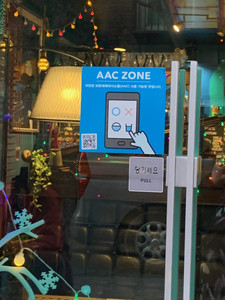
AAC Zone Sign
The "AAC Zone" was a small community designed to welcome individuals who use AAC to engage with shop owners, neighbors, and society in a more powerful and interactive way. The AAC Zone consisted of 11 local businesses, services, and facilities that welcomed patrons who have difficulty communicating.
Specialized communication books were displayed at localbusinesses' cashier counters and help desks. These books contain vocabulary that was unique to each of the environments. For example, the local library's communication book included vocabulary to assist a user in asking for help finding books, checking out books, and using the available technology. The local coffee shop's communication book included vocabulary that allowed customers to order specialized coffees and treats by pointing and choosing items from a picture and word-based menu.
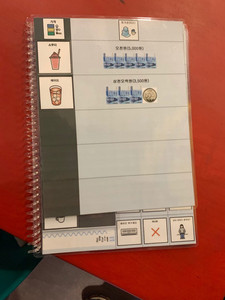
Coffee Shop Communication Book
Although this project was designed to benefit non-speaking individuals, the efforts benefited more than the targeted population. As a non-Korean speaking tourist, I entered a small coffee shop owned by a local gentleman. With the use of the coffee shop's communication book, I crossed verbal communication barriers and ordered a sweet potato latte effectively. The communication book, that was provided by Ms. Han, gave me the freedom to communicate effectively with the shop owner and enjoy a very positive experience.
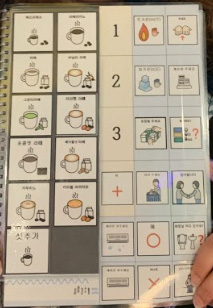
Coffee Shop Communication Book
The AAC Zone project removed communication barriers by creating an environment where all were welcomed and heard. The adoption of universal AAC supports would benefit society by creating a more accessible community.
—–
Laura Hoffman has worked as a rehabilitation engineer in the assistive technology field since the early 1990's. Recently, Laura decided to expand on her knowledge of how AT can benefit the end-user by acquiring her master's in education from George Mason University. After completing her degree, Laura accepted a position as a program coordinator for Missouri Assistive Technology. Her current role allows her the opportunity to meet with AT users to help them to overcome their challenges with the use of AT. Laura provides demonstrations on no-tech to high-tech solutions. Laura also oversees the Equipment Technology Consortium (ETC). Through ETC she provides short-term AT loans to Missourians as part of a "try before you buy" initiative.
—–
Jill E Senner
Editor-in-Chief
SpeakUP
Thank you for reading this blog post. The views expressed in this post are that of the author, and do not necessarily reflect the views and policies of USSAAC members and board members. No endorsement by USSAAC is implied regarding any device, manufacturer, resource or strategy mentioned. We would love to hear from you. Please share your thoughts with a comment below or send a message through our contact page.